

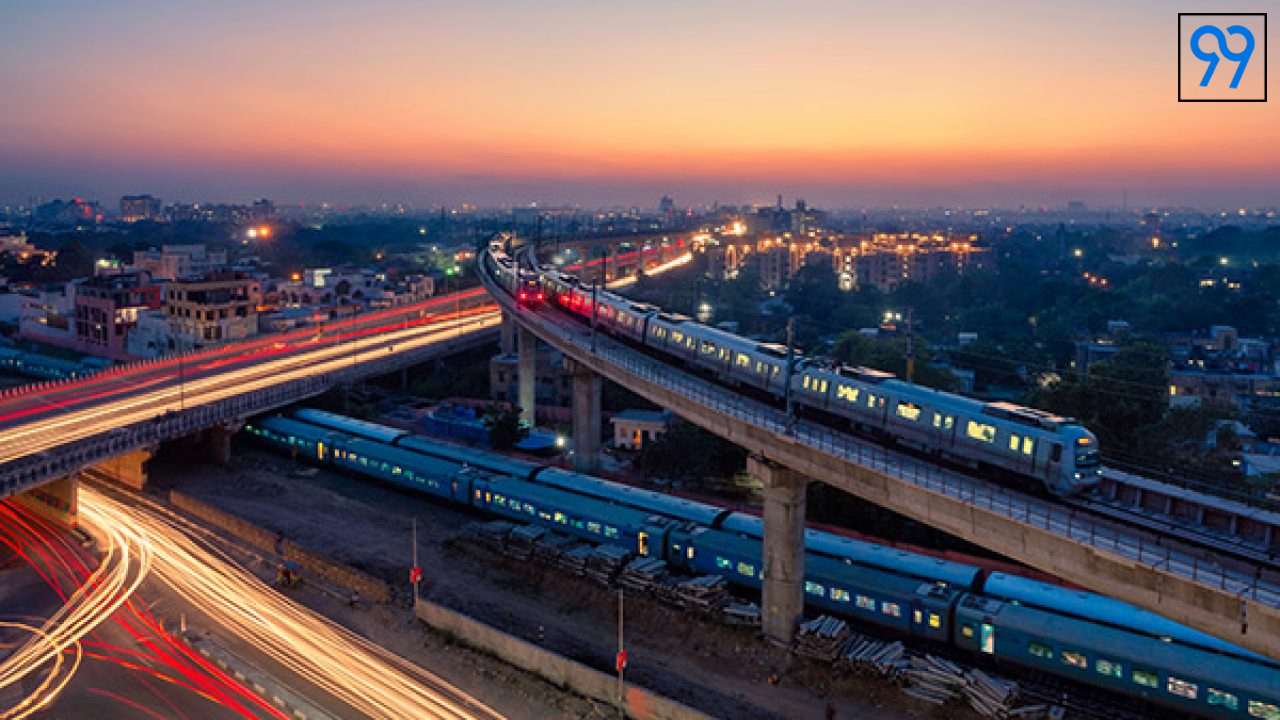
Jaipur Metro Beautiful Phase Of Pink City
The pink city of Rajasthan, Jaipur is an eye-catching place for tourism. Where it always establishes a very beautiful tourist spot for the tourists. And do you know the government of Rajasthan makes the development of such things to make jaipur a beautiful city like others?
In the capital city of Rajasthan, the Jaipur metro is a rapid transit system constructed on the mostly elevated part. The construction of the Jaipur metro was started on 13 November 2010 and the work of Phase 1 was completed in 2014.
Jaipur metro first started in two phases where the first phase began operational between Chandpole to Mansarovar on the day of 3 June 2015. After Delhi, Gurgaon, Mumbai, Bangalore, and Kolkata, the jaipur metro rail system is the 6th metro rail system in India.
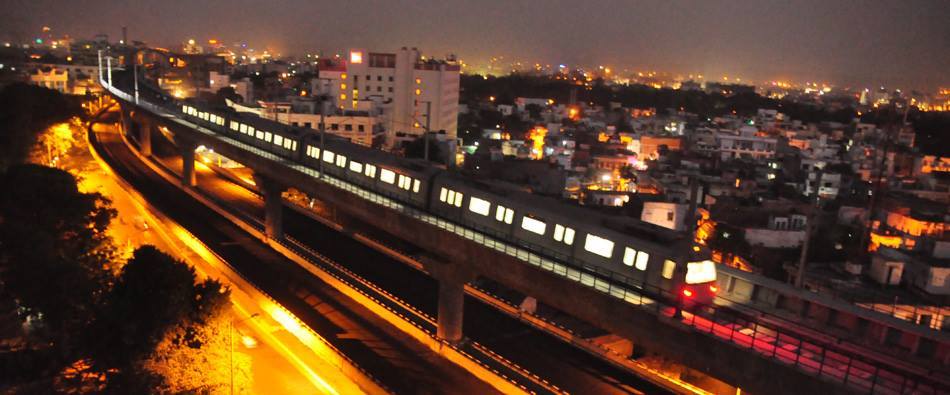
It is found as per the research that the Jaipur metro is the 1st metro in India that runs on a double-story elevated road and metro track and the fastest-built metro system. Jaipur metro rail system uses 1435 mm (standard gauge) tracks and 25 KV AC through overhead catenary like many metro systems in India.
The jaipur metro rail system comprises four coaches that run at the top speed of 80km/h where the headway between trains ranges from 10 minutes in peak hours to 15 minutes in non-peak hours.
The construction of the Jaipur metro rail is divided into two phases in the east-west and north-south corridors. Where the first phase of work has already been completed and started operational. The second phase encompasses a 23-km north-south corridor from Sitapura to ambabari.
The corridor for the second phase is 5 km below and 18 km above the ground. In the second phase, there are five underground stations and 15 elevated stations are under construction.
Details Of the Jaipur Metro Rail System
The purpose of commencing metro connectivity in Jaipur is, to keep in mind the rapid and fast development of commercial and industrial phases in the city. In the past decade, Jaipur’s population has grown exponentially because of the booming employment opportunities.
To enhance the public transport infrastructure, the Delhi metro rail system was brought as a consultant on board to help the metro work of the JMRC plan. In February 2011 the paperwork for the jaipur metro rail on the pink line began. In the future, it will be the fastest metro network in the country to reach the trial run stage after construction.
Remember one thing in Jaipur metro the first coach is reserved for women where eating, drinking, chewing gum, and smoking are restricted metro premises.
Route And Stations Of Jaipur Metro
As we already discussed, the phases of the Jaipur metro are divided into two parts. The first phase of the Jaipur metro route contains the pink line whereas the second phase includes the orange line. The route of Jaipur metro Phase-I is split into three parts, out of them two Jaipur metro routes are working while the third route is still under construction.
Still, the Jaipur Phase-II is currently in processing.
Phase-IA Of Jaipur Metro
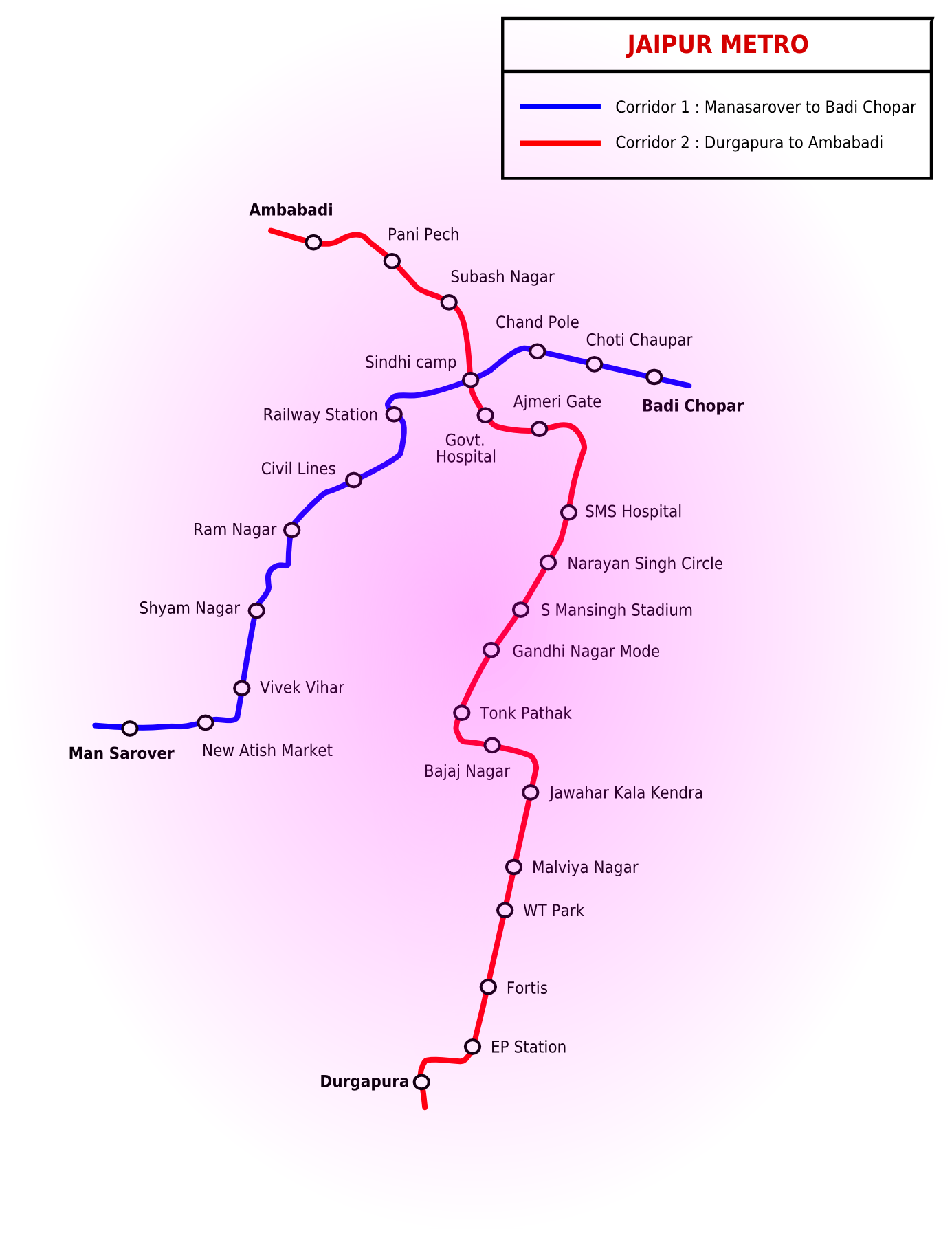
The Phase-I of Jaipur was completed in 2014 and has already become operational on the Jaipur metro network. The route of Jaipur metro Phase-IA connects from Mansarovar to chandpole. The distance of the Phase-IA jaipur network is 9.63 km long. The Jaipur metro route in public operations started in June 2015.
The route of the Jaipur metro is –
- Mansarovar
- New Aatish Market
- Vivek Vihar
- Shyam Nagar
- Ram Nagar
- Civil Line
- Railway Station
- Sindhi Camp
- Chandpole
Phase-IB Of Jaipur Metro
Given that it links Chandpole and Badi Chaupar, this is the extended portion of Phase-IA. Additionally, the Pink Line from Mansarovar Metro station to Badi Chaupar via Civil Lines and Chandpole is now complete thanks to this Jaipur Metro route. In September 2020, this Jaipur Metro line was made accessible to the general public. This section is 2.3 kilometers long in total.
Phase-IC Of Jaipur Metro
Phase-IC, which is still in the planning stages, will extend the Pink Line from Badi Chaupar to Transport Nagar. This Jaipur Metro route will be 2.85 kilometers long in total. If permitted, construction on this Jaipur Metro route should be finished by March 2025. This Jaipur metro route from Badi Chaupar to Transport Nagar would have three stations.
Phase-II Of Jaipur Metro
Phase-II of the Jaipur metro, now under construction, will use the Ajmeri Gate and the MI Road to link the Sitapura Industrial Area with Ambabari. The Jaipur Metro route is anticipated to be finished in 2021. This 20-station stretch, commonly known as the Orange Line, is 23 km long in total. Due to public outcry, this Jaipur Metro line is now being revised.
| Ambabari | Tonk Pathak |
| Pani Pech | Dev Nagar |
| Subhash Nagar | Gopalpura |
| Sindhi Camp | Mahaveer Nagar |
| Govt Hospital | Durgapura |
| Ajmeri Gate | Jaipur Airport Station |
| SMS Hospital | Sanganer |
| Narayan Singh Circle | Haldi Ghati Gate |
| S Mansingh Stadium | Pratap Nagar |
| Gandhi Nagar Mode | Sitapura Industrial Area |
Route Map Of Jaipur Metro Rail
Jaipur Metro With Low Power Consumption: Jaipur Metro Skyline Using 12800 LED Lights
In India, Jaipur maintains a blend of modern and traditional culture that is highly regarded. The Jaipur Metro Railway Corporation (JMRC) has built a brand-new skyline that shines at night. In the metro route, which travels a total of 9.8 kilometers from Mansarovar to ChandPole From a height of 5000 feet, we can readily observe that 12,800 LED lights have been used. These 12,800 LEDs use extremely little power, and their hourly rate is close to Rs. 250. (Two Hundred Fifty Rupees Only)
It has also been noted that the Jaipur Metro skyline appears to be the letters W or M when viewed from the Nahargarh Fort, tall buildings, or airplanes. The director of O & S (CS Ginagar) said “to make this tourist view for the Tourister to see, we will only allow the starting of this skyline for a certain amount of time”. He also stated that this will be used for emergency and maintenance programs.
Jaipur Metro Lines
There are two phases to the construction of the Jaipur Metro. Phase I includes the Pink Line, whereas Phase II includes the Orange Line. Phase I is presently operational, and Phase II is underbuilt. The project’s execution is under the control of the Jaipur Metro Rail Corporation Limited.
- The Pink Line Metro connects Badi Chaupar and Mansarovar.
- The Orange Line Metro runs from Sitapura to Ambabari.
Let’s examine these Jaipur Metro lines in more detail.
Pink Metro Line
The Pink line is the initial segment of the Jaipur Metro Rail. It links Mansarovar with Badi Chaupar. There are 11 metro stations along the 12.067 km circuit (8 elevated and 3 underground). Phase I-A and Phase I-B are the two phases that make up this process. Phase I-A from Mansarovar to Chandpole consists of nine stations, while Phase I-B only includes two stations, Choti Chaupar and Badi Chaupar. Phase I-length A is 9.718 km, whereas Phase I-is B’s 2.349 km.
Orange Metro Line
The Orange Line is the second planned line for the Jaipur Metro Rail. It is intended to connect Sitapura and Ambabari’s industrial districts. It is proposed to feature 20 metro stations over its 23-kilometer length (15 elevated and 5 underground).
Timing For The Jaipur Metro
To visit the Jaipur metro the timing is between 6.45 am and 9.00 pm. The jaipur metro works at a frequency of 10-15 minutes with changes based on peak and non-peak hours. At every station with the Jaipur metro route, it stops for 20-40 seconds.
Some Important Facts About Jaipur Metro System
- The Jaipur Metro Rail Project is anticipated to cost Rs 2025 crores.
- One of the Metro sector’s quickest projects to be implemented, the Jaipur Metro Rail Project was finished in just four and a half years.
- The state government of Rajasthan and its departments, including the Rajasthan Housing Board, Jaipur Development Authority, and Rajasthan State Industrial Development and Investment Corporation Ltd., are fully funding the Jaipur Metro project.
- Jaipur Metro is a good example of multi-modal integration in planning because it connects the Inter-State Bus Terminal and the Railway Station. Jaipur Metro Rail Corporation has already started Metro feeder services.
- As a result of the purchased rolling stock’s usage of regenerative braking, an endeavor to cut energy consumption resulted in 30% energy savings.
- The design includes a system for collecting rainwater.
- Water is available for free at every Metro station.
- The operation and maintenance workers, train operators, and station controllers make up about 30% of the Jaipur Metro’s workforce.
- In order to promote the use of smart cards, discounts of up to 15% have been offered.
- The introduction of tourist cards, such as the one-day tour card and three-day tour card, allows for an unlimited number of journeys during the days that the card is active.
- All Metro Stations feature the most recent security equipment.